
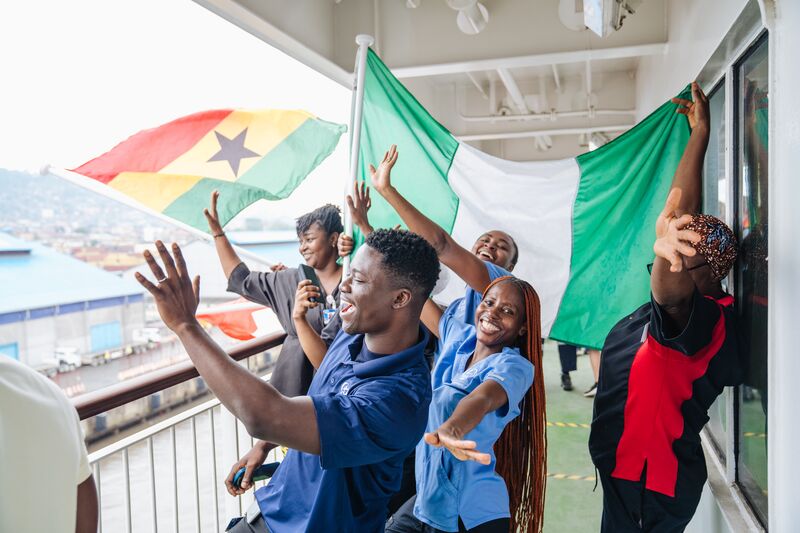
Over the past three years, thousands of people have climbed up and down the gangway of the Global Mercy™ while she docked in Freetown, Sierra Leone.
Some arrived seeking surgery for conditions that had kept them from school, work, or daily life. Healthcare professionals came for training. Volunteers from around the world stepped aboard to serve, while Sierra Leonean national crew members crossed the gangway each morning to support the mission at home.
Each person arrived with a different purpose, and many left with something new.
Hope Realised
When the Global Mercy arrived in Sierra Leone in 2023, a young girl named Naserry was among those waiting.
At five years old, Naserry suffered severe burns after falling into a cooking fire. Without access to the surgery and rehabilitation she needed, the scars tightened over time, limiting the use of her dominant arm and making everyday life difficult. At school, other children teased her, and she often hid her arm behind her back.
But Naserry’s aunt, Salamatu, never lost hope.
Years before, Salamatu saw a neighbour get treatment when Mercy Ships visited Sierra Leone. She believed her niece could be healed too, so she brought Naserry to live with her in Freetown and waited for the ship to come back.
In 2023, that hope finally came true.
After surgery aboard the Global Mercy and months of rehabilitation, Naserry could move her arm again and returned home with renewed confidence. “People used to laugh at me,” she said. “No more.”
For many in Sierra Leone, the Global Mercy’s arrival that year was not the start of the story.
Mercy Ships first came to Freetown in 1992 on their first hospital ship, the Anastasis. Over the years, they returned many times, building trust and strong relationships with the people of Sierra Leone.
The Global Mercy’s third consecutive field service marked the eighth visit by Mercy Ships to the country and the longest continuous period of service in Sierra Leone’s history with the organisation.
Naserry’s story is one of thousands that unfolded during that time.
Between 2023 and 2026, Mercy Ships provided more than 5,430 surgeries and more than 17,100 dental procedures. Each number represents someone who went back to school, supported their family, chased a dream, or rejoined their community with new confidence.
Sierra Leone’s Minister of Health, Dr. Austin Demby, summed it up: “It’s not individuals. Five thousand families benefited from this.”
Carrying the Work Forward
Beyond surgeries, the past three years have made a difference through the people who will keep the work going.
For Betty Koker, that journey began with a personal loss.
After her mother died in childbirth, Betty made a choice that changed her life.
“I decided to become a nurse so that I can help people, especially children, not to become orphans.”
That determination eventually led her to Connaught Hospital, Sierra Leone’s largest public hospital. In 2024, she participated in a nurse mentorship program developed through a partnership between Mercy Ships and the Ministry of Health.
Betty strengthened her skills and confidence and today, she uses what she learned with her patients and shares it with her coworkers.
Stories like Betty’s happened hundreds of times over the last three years.
Over 600 healthcare workers participated in Mercy Ships’ Education, Training and Advocacy Programs, totalling more than 106,000 hours of learning. Programs like the Nurse Anaesthesia Diploma, Physiotherapy Mentorship, Sterile Processing Training, medical education sponsorships, and the Safer Surgery Program helped healthcare workers across Sierra Leone gain skills they’ll use for years.
That future is already taking shape.
Graduates of the Nurse Anaesthesia Diploma Program now work in government hospitals, while healthcare professionals who once attended training sessions are now teaching and mentoring others.
Making a Difference Beyond the Ship
The impact is also clear in people like Harry Kargbo.
Harry, a Sierra Leonean national crew member on the Global Mercy, spent three years seeing lives change. He met patients before surgery and saw them again after they healed. He watched people gain confidence, go back to their families, and take on new opportunities they once thought were out of reach.
He also witnessed something less visible.
A shift in mindset.
The lessons he saw on the ship, teamwork, accountability, compassion, and service are now spreading to workplaces, hospitals, and communities all over Sierra Leone.
For Harry, that impact extends far beyond the ship’s departure.
“Babies that are yet unborn will benefit from proper care as a result of the training Mercy Ships has been doing,” he said.
Dr. Demby saw the same thing on a national level.
For him, one of the biggest contributions was not just the technical skills shared, but the culture that accompanied them.
“The ability to work as a team, the ability to put empathy behind what you’re doing, the ability to care, the ability to support each other in a complementary manner,” he said. “It’s the softer side of Mercy Ships’ presence here that, for me, was the most formidable.”
The Partnership Continues
Over the last three years, Mercy Ships and Sierra Leone partnered to meet immediate surgical needs and invest in the future of healthcare.
Working with the Ministry of Health, Connaught Hospital, schools, and healthcare workers, Mercy Ships helped establish programs that will continue beyond the Global Mercy’s departure and contributed to the country’s national plan for surgical care.
These efforts are not ending. Mercy Ships is still involved in Sierra Leone, supporting healthcare training and mentorship so the work started on the Global Mercy keeps going on land.
Across Sierra Leone, the impact of the past three years can already be seen in lives like Naserry’s, in nurses like Betty, and in healthcare professionals who are now sharing what they have learned with others. While the Global Mercy has departed, the partnerships, programs, and people who carry this work forward remain.
Reflecting on that impact during a recent farewell event, Sierra Leone’s President Julius Maada Bio said: “The ship may leave, but the legacy remains.”
Thousands more are still waiting for safe surgical care. Learn how you can be part of the mission.
Recent Comments