
A long-awaited reunion is on the horizon! The Global Mercy™, after three consecutive field services in Sierra Leone, is preparing for a new mission in Ghana.
“Mercy Ships has been so instrumental in furthering the health sector of Sierra Leone,” said Gabriel, a Sierra Leonean nursing student working in Ghana. “It’s showing everywhere, and we appreciate them.”
In August 2026, the hospital ship Global Mercy will sail to Ghana for a period of 10 months. During this time, at no cost, patients from across the country will have access to specialised surgeries that include tumour removal, cleft lip and palate repair, paediatric orthopaedic surgery, surgery for cataracts, reconstructive plastic surgery, obstetric fistula repair, and general and paediatric surgeries.
To leave a lasting impact, Mercy Ships will also work closely with Ghana’s government to build medical capacity and advance the nation’s surgical and anaesthetic systems through education and training programs.
“It comes to augment the services that the government, and for that matter the Ministry of Health, is giving to the people of Ghana,” said Dr. Hafez Adam Taher, Director for Technical Coordination at the Ministry of Health of Ghana.
A Partner Since the Anastasis
The enduring history of Mercy Ships and Ghana began in 1991. Back then, the organisation worked alongside Ghana’s leadership and citizens to provide surgical care and training on board its flagship vessel, the Anastasis, which was retired shortly after departing in 2007. This upcoming mission will mark Mercy Ships’ fifth visit to the country.
“The aim is to provide free, safe surgical care to Ghanian people. Whilst we’re taking care of the immediate needs in surgeries, we’re also looking at where we can provide or improve capacity,” shared Mercy Ships’ County Director in Ghana, Michael Nkeze.
‘Akwaaba’ to Ghana
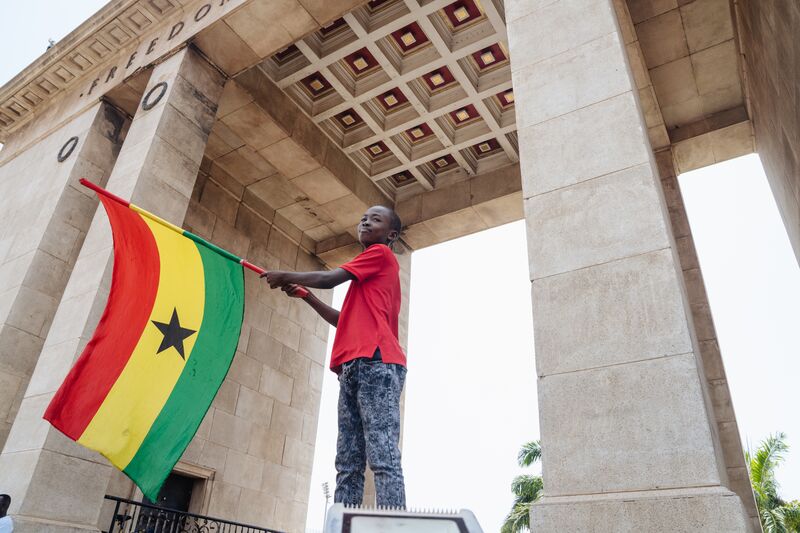
Nicknamed the ‘gateway to Africa’, Ghana is well-known for its breath-taking landscapes, rich cultural heritage, diversity and a unique trail of history.
“It’s the first African nation south of the Sahara to attain independence,” shared Dr. Hafez Adam Taher.
From its vibrant colours and culture reflected in the weave of Kente or Fugu to its flavoured, authentic jollof rice—and the pulsating energy of its cosmopolitan streets of Accra, the nation’s capital—Ghana is truly a place worth calling home. Often counted among the friendliest nations in Africa, Ghana’s Akwaaba (welcome) spirit meets you at the airport and stays with you for a lifetime.
“The warmth in the country is really massive. I think one of the things that Ghana prides itself in is its food, and in the people, too. They’re really, really welcoming,” shared Michael Nkeze. “And this is why I like that Akwaaba is very unique in its way. So, as soon as you arrive in the country, you see it everywhere.”
Why Ghana?
Sylvester Atitsogbe, a teacher and humanitarian who works mostly in rural Ghana, heard about Mercy Ships in 2012. Since then, he has travelled to Benin and Guinea during their field services, helping Ghanaian patients receive free surgery on the Africa Mercy®.
Sylvester’s first trip was primarily assisting orthopaedic and ophthalmic patients, one of which he met in a major hospital in Accra. “We found him there begging people to help him have surgery because the cost was too much for the family to bear,” he recounted. “Mercy Ships came through and they are all fine now.”
With numerous barriers to accessing quality surgical care, especially in rural areas, the surgical need in Ghana is significant. Over 77% of surgical operations performed in Ghana are essential procedures, most of which are performed at district-level hospitals that lack consistent access to imaging and operating room essentials. Tertiary facilities have access to these modalities but lack consistent access to oxygen and surgical supplies. All of these facilities share severe workforce inadequacies, with most specialty surgeons concentrated in urban areas. Moreover, even if they are able to secure a surgical slot, Ghanaian patients cover up to 91% of their own direct medical costs out of pocket, since national health insurance coverage is limited.
The government of Ghana has been working to address the gap in its country’s surgical system, but believes that priorities can be achieved more efficiently and at a higher quality when partnerships are embraced.
“We think collaboration is key…At the Ministry of Health, we have an open-door policy,” said Dr. Hafez Adam Taher. “The partnership is actually working for us so that we identify various gaps and various partners fill in the gaps.”
Mercy Ships comes alongside the Ministry of Health to ensure progress toward the goals outlined in Ghana’s National Surgical, Obstetric, and Anaesthesia Plan (NSOAP).
Hon. Kwabena Mintah Akandoh, Ghana’s Minister of Health, highlights the importance of NSOAP: “It ensures that essential surgical, obstetric, and anaesthesia services are incorporated into Ghana’s universal health coverage strategy. This is an important step toward reducing maternal and child mortality, effectively managing trauma cases, and strengthening emergency and critical care services throughout the country.”
Since 1990, Mercy Ships has served 14 African countries, particularly in West Africa, with 47 field services focused on direct medical services and education and training. Mercy Ships’ mission in Ghana this year will build upon this legacy, ushering the organization and the country into active partnership. Join us in Ghana and volunteer this August 2026!
Recent Comments