
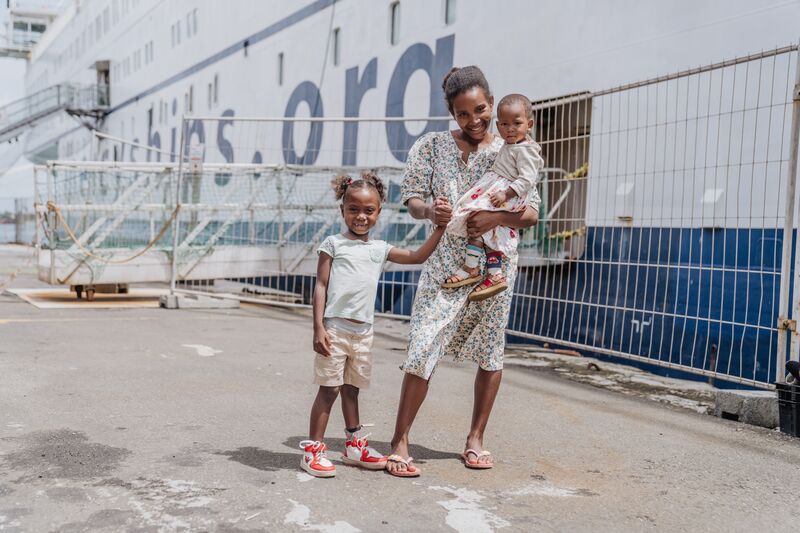
Tina was born with her left foot twisted on its side. From the very first days of her life, walking was already a challenge waiting to unfold.
In their community, Tina’s family tried to help her using the knowledge and resources they had at the time. Her mother, Christina, took her to a traditional healer, who massaged Tina’s leg in the hope that it would straighten. But nothing changed.
“So, I said, ‘Just leave it like that. It will recover once someone provides treatment,” Christina explained, holding onto hope that one day her daughter would find healing.
Years passed. Tina grew older with the same difficulty. Walking long distances remained painful. She could not wear sandals, and she often needed support to move from one place to another.
For Tina’s family, school did not feel possible yet when every step required help. So, they made the difficult decision not to enrol her and kept her at home, uncertain of what her future might hold.
Tina’s story reflects a broader reality in Madagascar. Clubfoot is one of the most common congenital conditions worldwide, and in Madagascar, the need for treatment is significant.
“[Globally], about one in every 800 babies is born with clubfoot [each year],”explained Nick Veltjens, a Mercy Ships physiotherapist and Clubfoot Mentoring Program Manager. “That makes it about 1,200 kids each year in Madagascar.” With new cases emerging every year, the need for treatment continues to grow, making sustained support and expanded expertise essential.
A national clubfoot program was established in Madagascar nearly a decade ago, resulting in clinics across the country and many babies and young children receiving early treatment. However, for older children who miss early care, the journey is longer, and the need remains.
“There is a very good national clubfoot program here in Madagascar,” Veltjens said. “But there’s still a big gap between the children that are born each year and the number that are being treated.”
A Program Built to Strengthen
Mercy Ships first began supporting clubfoot care in Madagascar in 2015, helping train local teams to treat young children using the Ponseti method, a gentle approach based on serial casting and careful correction.
“2015 marked the beginning of clubfoot treatment using the Ponseti method here in Madagascar, with support from Mercy Ships,” said Dr. Saholy Razafindranaly, a general practitioner and Ponseti trainer in Toamasina.
“More than 3,000 children that we know of have been treated and healed from clubfoot here in Madagascar since 2015,” she added.
When the Africa Mercy® left in 2016, the work continued through MiracleFeet, a nonprofit organization that provides clubfoot treatment to children, in partnership with the Ministry of Health. Together, these efforts helped scale care nationwide
and strengthen long-term treatment capacity.
Yet many children do not have access to timely treatment. According to Dr.Saholy, several challenges continue to affect access: too few specialized health workers, the long distances families must travel to reach treatment centers, and communities where people still believe clubfoot cannot be cured.
When Mercy Ships returned to Madagascar in 2025, the focus was not on replacing what already existed but on strengthening it, especially for older children with delayed-presenting clubfoot.
“Many children miss early treatment,” Veltjens said. “When that happens, they grow older with untreated clubfoot, and the condition becomes more complex to manage.”
It was within this gap in care that Christina found the next step for Tina.
“We were walking along the street when someone said, ‘Go to Hôpitaly Be [the local hospital],’” Christina recalled. “They treat feet like this, for adults or children.”
She went, hoping her daughter’s foot could be treated there.
At CHU Analankininina, known locally as Hôpitaly Be, Mercy Ships had set up the Clubfoot Mentoring Project. There, Tina became one of the children selected for care.
Unlike earlier programs focused on babies, this initiative addresses delayed-presenting clubfoot in children older than two, where treatment requires more time, careful planning, and advanced skills.
But the goal was not only to treat patients, but also to train and mentor clinicians so they could become confident practitioners, future trainers, and leaders.
Step by Step, A New Beginning
Tina’s treatment began with serial casting, the foundation of the Ponseti method. Each week, her foot was gently stretched and placed into a cast, gradually guiding it toward its correct position.
With older children, Veltjens explained, the process takes longer. Casting can continue for months, slowly stretching tight feet and reducing the need for more invasive surgery later. In Tina’s case, this careful preparation mattered.
“What we don’t want to do is jump straight to surgery,” he said. “What we want to do is slowly stretch the foot with the casts… to really correct the foot into a really good position so that the surgery that they need is just very minimally invasive.”
For the mentoring participants, each cast was also a lesson. The Ponseti method is hands-on. Proficiency requires repetition, precision, and follow-up. And for some older children, even after casting, a procedure is still needed to complete correction and reduce relapse risk. That is where the program also trained surgeons.
Dr. Herinatolotra Onja Ramanamisata, a Malagasy surgeon with more than two decades of experience, described what changed for him through the training.
“Before… what we usually did for clubfoot was almost always surgery,” he said. “We noticed that it was difficult for patients… and sometimes we even had to redo the surgery when we relied only on surgery.”
Through the mentoring program, he learned that “even for late-presenting clubfoot, the Ponseti method can still be applied.”
“And when surgery is eventually needed,” he explained, “the surgery becomes lighter and less complex.”
Dr. Rachel Buckingham, a Mercy Ships Volunteer Pediatric Orthopedic Surgeon from the United Kingdom, described the purpose behind that mentorship.
“A big part of the work of Mercy Ships is to train local health care professionals,” she said. “So that Mercy Ships becomes, hopefully in the future, unnecessary.”
She added that the Ponseti method is particularly suited for low-resource settings. “It’s not a very expensive thing to do… something that is sustainable,” she said.
When Knowledge Stays
After surgery, Tina’s journey continued into its most delicate phase: rehabilitation. Strengthening, balance, and long-term follow-up help protect what casting and surgery corrected.
For Dr. Saholy, this stage reflects the deeper strength of the mentoring model. Mercy Ships not only provides care. “They also give training,” she said. “That means they don’t keep their knowledge to themselves, but they share it.”
She described what she hopes will come next. After this long, combined training, both theory and practice, the goal is mastery and multiplication.
“After this training… to be able to pass on that knowledge and skills we have received to other health care workers,” she said. That is the arc the program is designed to support. Patients like Tina receive care now, and local teams gain confidence for later.
“When you see a child improving, and at the same time you see a local team gaining confidence,” Veltjens said, “that’s sustainability. The treatment will finish, but the knowledge will stay.”
For Christine, the hope is simpler and more personal. Her little girl, who once needed help for every step, is moving toward a different future. Tina’s foot has been straightened, and a system is being strengthened around her, so that when Mercy Ships sails away again, children who once fell through the cracks can still find care in Madagascar.
Learn more about Mercy Ships’ training and mentoring programs and how they are strengthening local healthcare systems for long-term impact.
Recent Comments