
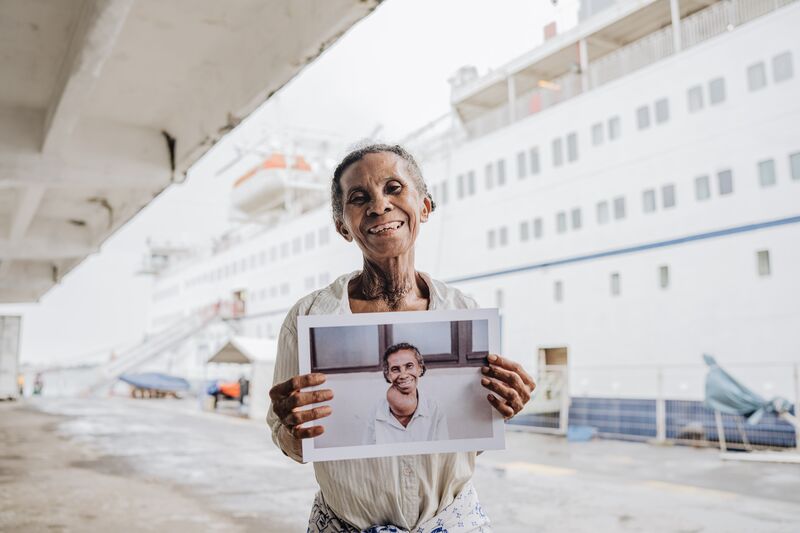
For more than a decade, Vaviroa lived with a growing goiter on her neck in the small village of Madirovalo, Madagascar. But the physical burden was only part of her story. She was also carrying the heartbreak of losing her only son and the loneliness that lingered.
Once, she worked as a farmer in Mahajanga, rising early to tend her fields. But as the swelling on her neck grew and a leg injury made physical labor more challenging, she could no longer continue.
“It is not painful, and I have no problem breathing,” she said. “But I stopped working because of my age and my leg.”
Eight years earlier, her only son disappeared. Police and members of her community searched for days, but he was never found.
Since then, Vaviroa has lived alone, relying on the support of friends and neighbors.
“Some people in our village give me food for my daily needs,” she said softly. “They even give me clothes.”
Despite her hardships, Vaviroa remained connected to her community. She enjoyed spending time with others and was known for reciting poetry to encourage children to study and even teach young men express their feelings.
“I love to be with people,” she said. “I love to recite poetry, and I’m going to make a poem for Mercy Ships when I’m healed.”
Among those who knew her story was Ester, a local nurse who worked at a nearby health centre. She often saw Vaviroa pass by with the visible mass on her neck. When Ester heard about Mercy Ships from a cousin living in Toamasina, she decided to visit Vaviroa at home. She shared news that a hospital ship was coming to Madagascar to offer free surgeries.
But there was one challenge. The screening centre was days away, and Vaviroa had no way to get there.
Ester paid for her transportation to the screening centre twice and later helped her travel to the assembly point where she could board a bus for transportation to Toamasina for her to be evaluated for surgery.
The journey was long, but it led Vaviroa to the Africa Mercy®, where she was welcomed by volunteers from around the world.
A New Chapter
When she arrived for screening, clinical caregivers noticed another challenge with which she had quietly been living. She was walking with a stick for support, and her flip-flops were held together with a makeshift elastic .
“Her cane was just a stick,” said Kalinda Ramsaran, a volunteer physiotherapist from Canada. “And she was trying to fix her flip-flops with a tourniquet from her recent laboratory visit for blood work.”
The rehabilitation team learned that Vaviroa had fallen from a tree as a child and broken her leg. It healed improperly, leaving one leg five centimetres shorter than the other. Before surgery, the team provided her with a proper crutch and created a temporary shoe to help improve her balance.
Later, they developed a longer-term solution.
Kalinda said “Our wonderful carpenter made a wooden piece that screws onto her shoe,” as a compensating platform. . “If the shoe wears out, she can reattach it to another one. She should be able to use it for the rest of her life.”
With her new shoe, Vaviroa now walks more steadily than she has in years and can imagine new opportunities for herself.
“When I go back home after surgery,” she said, “I’ll try to find financial support and start raising farm animals like ducks or geese to make a living.”
She also hopes to visit her local Nurse Ester to thank her for helping make her journey possible.
Before leaving the Africa Mercy®, Vaviroa kept her promise. She wrote a poem to thank the volunteers who cared for her. “Thanks to Mercy Ships for their care,” she wrote, “What a blessing you accomplished here.”
Today, Vaviroa is preparing to return home, with renewed hope as she plans to begin raising animals and reconnect with the people who helped her along the way.
You can be part of stories like these. Learn how you can be part of the mission today.
Recent Comments