
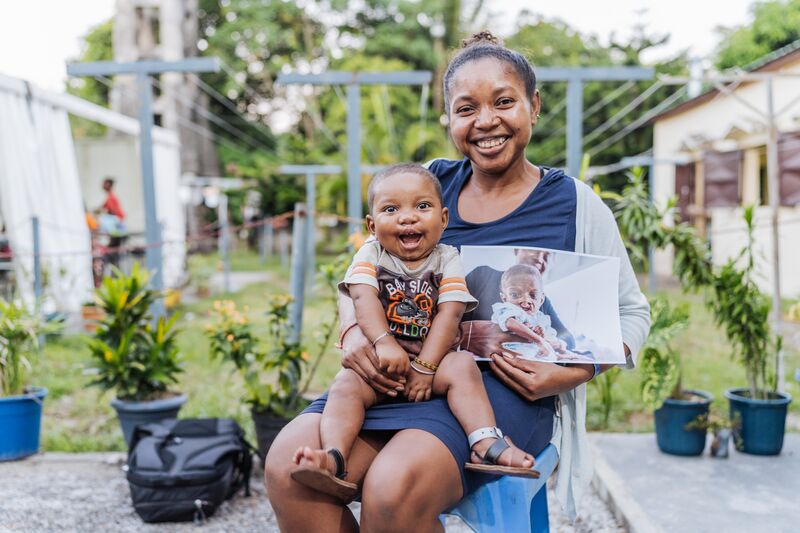
In Malagasy tradition, new mothers are expected to remain in bed for weeks after giving birth. But just days after Alfredo was born, Doxie made a decision that would shape her son’s future. Despite her exhaustion and physical weakness, she wrapped her new-born in her arms and went to a Mercy Ships screening centrw at a local hospital.
“I was determined that day,” she said. “I needed help for my baby.”
Alfredo’s birth had come earlier than expected. At seven months, he entered the world quietly, not in a hospital room, but at his family’s home. During her pregnancy, Doxie regularly travelled from her rural village to the port city of Toamasina to attend prenatal check-ups and stay close to family. As she neared her delivery date, she remained in the city, hoping it would give her and her baby better access to care.
Nothing prepared her for what followed.
Alfredo was born with a medical condition no one in their family had ever seen. He had bilateral cleft lip and palate, a condition where the upper lip and the roof of the mouth did not fully close during his development in the womb.
Doxie’s family hesitated to show him to her. They were afraid of how she might react.
“When they showed me the baby the next day, I was really surprised,” Doxie remembers. “I didn’t expect that. When I was pregnant and had ultrasounds, I wasn’t aware of this condition.”
Joy and fear collided. “I said to the Lord, ‘What should I do for this baby, since you have given him to me?’” She recalled. “I was so afraid because I wasn’t able to breastfeed him.”
Due to the condition, Alfredo struggled to latch and feed. Doxie found herself facing an overwhelming reality. “At that time, I was feeling sad,” she said, “but also happy, because I had a son.”
At the screening, the team explained that Alfredo was still too young and too small for surgery. At just a few days old, he needed time to grow stronger before an operation could be considered. Doxie was given an appointment for a later date, when Alfredo might have gained enough weight, along with guidance on feeding and care in the meantime.
At that point, no one yet knew how fragile Alfredo would become.
It was not the immediate solution she had hoped for, but it was a plan, and it was hope.
When There Was Nowhere Else to Turn
Doxie returned home to her village carrying an appointment date and doing everything she could to care for her son. But feeding Alfredo remained difficult. Without the right equipment, steady access to baby formula, or the means to sustain it long term, his health began to decline.
“I tried my best to find food for him,” she said. “I bought milk powder, but I couldn’t afford it for long.”
Desperate, she brought him back to the local hospital in the city. They stayed, hoping for recovery. But eventually, the family ran out of money.
“We told the doctor that we were going to leave because we didn’t have any solutions,” Doxie said. “My family suggested I go home to the village and wait, believing there was nothing more that could be done.”
The words shattered her. Alfredo was still alive. She was not ready to give up.
That night, as she prepared to leave the hospital the next morning, Doxie broke down. “I was so sad. I cried and refused to get ready,” she said. And then, in the middle of her despair, something changed.
Amid her despair, she found a moment of clarity. Drawing strength from her faith, she decided to take Alfredo to Mercy Ships, believing there might still be an answer.
The next morning, while others believed she was returning home, Doxie made her way to the port where the Africa Mercy® was docked. She did not know who to speak to or what would happen. She only knew she had to try.
The medical team immediately recognised how fragile Alfredo was.
“I remember one of my colleagues coming to my desk and saying, ‘There’s a baby outside, and I’m not even sure if he’s alive,’” recalled Cobie Waasdorp, a volunteer nurse from the Netherlands. “He was so small.”
Victoria Pannill, a volunteer nurse from the United States, remembers the moment Alfredo arrived on the dock. “He was flagged as being severely malnourished,” she said. “He weighed just 2.6 kilograms at six months old. He should have weighed close to that when he was born.”
The team put him on the infant feeding program. “We had to feed him very, very slowly,” Victoria explained. “Five milliliters at a time, every hour, then ten, then fifteen, so that he could gain weight at a safe rate.”
Cobie remembers listening for the sound that revealed to her Alfredo still had strength. “When I heard him cry, I knew this boy is a little fighter,” she said. “That cry told me he was going to make it.”
In the first days, Alfredo began to improve, small changes that felt enormous to his mother. Doxie watched him respond, feed by feed, hour by hour. “I couldn’t hold back my tears of joy,” she said, “because I didn’t expect that my child could be healed.”
What Became Possible
As Alfredo continued to gain weight steadily, Doxie took him home to wait for surgery. Mercy Ships provided feeding support and education, and the dietician team helped set Doxie up with what she needed to care for Alfredo while they were away.
Months later, when Alfredo returned, he was almost unrecognisable.
“He was one year old and weighed about 7.6 kilograms. I only recognszed him because I recognised his mum,” Victoria said.
Cobie smiled as she described him. “Chubby cheeks. Smiling. A little fat baby, how a baby is supposed to be.”
When the day of surgery arrived, Alfredo was ready. For Doxie, the surgery carried deep meaning.
“God really didn’t abandon us,” she said. “Even when I felt discouraged, He was always there to comfort us.”
Her dreams for Alfredo are simple and powerful. “My wish for him is that he will grow up and study like every other kid and have a better future,” Doxie said.
And when they returned home, she found herself sharing the story repeatedly because people struggled to believe it.
“When we arrived, many people did not believe it,” she said. It was only after I showed them the before-and-after photos that they believed me.”
Care, commitment, and access make stories like Alfredo’s possible. Learn how you can support this work.
Recent Comments