
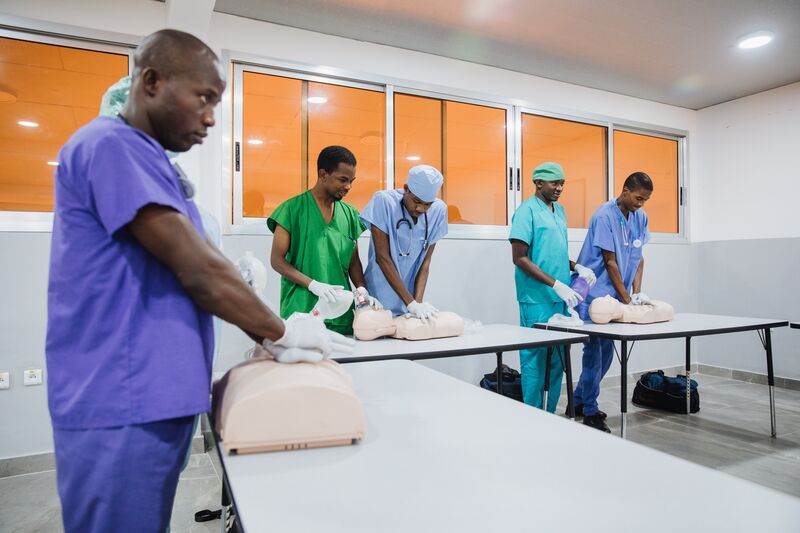
Across Africa, nurses are the backbone of patient care. They are there before surgery, through recovery and during every step of the healing process. Mercy Ships’ infection control workshops recognise this reality and build on it, giving nurses the skills to protect patients from preventable infections and support safer outcomes in hospitals where the stakes are high and resources can be tight.
Through hands-on training, mentorship and structured clinical education, these workshops help African nurses grow in confidence across areas like hygiene practice, wound care, sterile technique and post-operative monitoring. The training is practical, focused and designed to stick.
For Mercy Ships supporters, this work reflects something important: that sustainable humanitarian healthcare in Africa is built on what local teams can do long after a hospital ship has sailed. It is about equipping nurses to lead on patient safety within their own wards, hospitals and communities.
Mercy Ships and Practical Nursing Education
Mercy Ships is best known for providing free surgical care across Africa. But surgery is only part of the picture. A central part of the mission involves education, mentorship and building lasting medical capacity alongside local healthcare teams, programs that help nurses, doctors and allied health professionals develop skills that continue improving patient outcomes long after a ship has left port.
Hospital ship nursing education places African nurses in a focused, supportive learning environment. Rather than classroom theory alone, workshops connect learning directly to real hospital situations. That connection makes training more memorable and far easier to apply in daily care.
Why Infection Control Training Matters
Preventing infection is one of the most important things any healthcare system can do. Strong infection prevention gives patients a better chance of healing well after surgery, recovering without setbacks and going home safely. In surgical settings particularly, clean hands, sterile equipment, careful wound care and consistent post-operative monitoring all directly reduce risk.
The WHO estimates that up to 10% of patients in developing countries acquire at least one healthcare-associated infection during treatment, a rate significantly higher than in high-income countries. A large proportion of these infections are preventable with effective training and consistent practice.
For nurses working in busy wards and operating theatres across sub-Saharan Africa, evidence-based infection control is not abstract knowledge. It is a life-protecting skill set with measurable effects on whether patients live or recover well.
Supporting African Nurses Through Workshops
Mercy Ships nurse workshops in Africa cover the practical skills nurses need and can use immediately: hand hygiene, safe dressing changes, patient observation, cleaning routines, waste handling, sterile technique and clear communication between clinical teams. These may seem like foundational topics, but consistently applying them is what separates high-risk care environments from safer ones.
The workshops also respect and build on the experience nurses already have. Rather than treating local knowledge as something to be replaced, Mercy Ships training supports professional development through respectful, collaborative learning and shared clinical practice.
Building Confidence in Ward Nurse Infection Prevention
Ward nurses are often the first to notice small changes in a patient’s condition. They support wound care, reinforce hygiene, help keep clinical spaces clean and watch for early warning signs. That daily vigilance is especially important after surgery, when patients are most vulnerable to infection.
By strengthening these everyday habits, Mercy Ships infection control training helps nurses trust their own clinical judgement more. A nurse who notices something slightly off with a wound, a temperature or a patient’s behaviour and feels confident enough to act on it can prevent a minor concern from becoming a serious complication.
Strengthening Safer Surgery Across Africa
Safe surgery is a team effort. It depends on nurses, sterile processing staff, theatre teams, ward staff and recovery teams all working to a shared standard. When each person understands how infection prevention applies at their stage of the patient journey, from pre-operative preparation through to discharge, risk drops across the board.
Mercy Ships’ work on hospital ship effectiveness in 2024 shows the scope of this: over 923 local healthcare professionals were trained, with more than 159,000 hours of medical education delivered across sub-Saharan Africa. That kind of investment in people builds safer surgery from within local systems.
The Role of Sterile Processing in Patient Safety
Sterile processing might not be the most visible part of nursing, but it is one of the most consequential. Surgical instruments must be cleaned, prepared, sterilised and stored correctly to protect patients during operations. When that process breaks down, the risk of surgical site infection increases significantly.
At Connaught Hospital in Freetown, Sierra Leone, Mercy Ships partnered with the Sterile Processing Education Charitable Trust (SPECT) to run a two-week hands-on program for 20 nurses. Participants from the operating theatre and ward teams practised scrubbing instruments, removing organic material from grooves and crevices, inspecting each other’s work and applying proper storage protocols. One participant, operating theatre nurse Larry Lawrence, noted afterwards that the training had changed how he approached sterilisation immediately after operations and that he planned to train other staff on what he had learnt.
In resource-limited settings, building this kind of reliable sterile processing system has lasting impact. It reduces avoidable infection risks and gives operating theatre teams a safer, more consistent environment to work in.
Reducing Surgical Site Infections
A surgical site infection can delay healing by weeks, increase pain and discomfort, and place serious pressure on both the patient’s family and the wider healthcare system. Preventing them is not a single action but a pattern of careful, repeated habits: clean technique, proper wound care, thorough patient observation and safe dressing changes performed consistently by trained staff.
Mercy Ships’ workshops reinforce those habits in practical, achievable ways. Nurses leave with techniques they can apply the next day and pass on to colleagues. That transfer of knowledge is where the real multiplication of impact happens.
Supporting Post-Operative Infection Control
The days immediately after surgery are often where the trajectory of recovery is decided. Nurses play a central role during this period, checking wounds, monitoring temperature, reinforcing hygiene, spotting warning signs and helping patients understand how to care for themselves at home after discharge.
Good post-operative care also builds trust between communities and healthcare services. When patients and families see nurses providing attentive, knowledgeable support, it strengthens their confidence in the local health system. That trust matters for whether people seek care early when they need it.
Mentorship That Outlasts the Ship
Formal training workshops are valuable. Mentorship goes a step further. When experienced healthcare professionals work alongside nurses through real patient situations, ask questions together and practise skills in context, the learning sticks differently. It builds both competence and confidence.
Mercy Ships nurse mentorship programs are particularly effective because the benefits ripple outward. A nurse who receives strong mentorship can support colleagues, guide junior staff and eventually mentor the next generation of nurses. One workshop, delivered well, can influence patient care for years.
At Connaught Hospital, this model is already producing results. Nurses who participated in the mentorship programme are taking on leadership roles and guiding peers, creating what Mercy Ships describes as a lasting culture of quality care and continuous learning.
Clinical Training on a Hospital Ship
The hospital ship environment offers something distinctive as a learning setting. Nurses can observe safe systems operating in real time, take part in structured education and connect clinical theory directly to patient care. The Global Mercy’s simulation laboratory provides healthcare workers with a space to practise skills safely before applying them in real clinical situations, an approach that supports both accuracy and confidence.
Volunteering with Mercy Ships as a nurse or healthcare trainer gives Australian professionals the chance to contribute to this model directly, sharing skills in an environment where the demand for clinical education is real and immediate.
Strengthening African Healthcare Systems
Healthcare system strengthening is a long-term project that depends on investing in people first. When nurses gain solid infection control skills, those skills spread across wards, theatres and hospitals. Colleagues learn from each other. Standards lift gradually and durably.
According to the WHO’s infection prevention and control guidelines, effective IPC programs depend on trained personnel applying consistent practices, not just policies on paper. Mercy Ships’ training model addresses exactly this: equipping the people who deliver care daily with evidence-based skills they can sustain independently.
Empowering Local Healthcare Workers
The measure of effective humanitarian healthcare training is not how much help comes from outside, but how much capacity is left behind. Nurses who receive quality infection control training can adapt that knowledge to their own clinical settings, teach others and contribute to safer care systems that operate on their own terms.
Mercy Ships’ approach to community and family health reflects this consistently: building local capacity, reducing reliance on external support and respecting the skill and dedication of African healthcare professionals. Lasting improvement in healthcare is most powerful when local nurses and clinical teams are equipped, trusted and supported to lead it.
Why This Matters to Australian Supporters
For Australians who care about nursing, medical volunteering, ethical giving and global health, Mercy Ships’ workshops offer a clear picture of how practical healthcare support creates long-term value. Training nurses in infection control is not a short-term fix. It is an investment in the people who will keep improving patient care for years to come.
Donations to Mercy Ships Australia directly fund these kinds of programs, nurse mentorship cycles, sterile processing training, simulation days and ward-based learning. Every dollar that goes toward training local healthcare workers is a dollar that multiplies.
A Positive Future for Nursing Education
African nurses who take part in Mercy Ships’ workshops leave not just with new techniques but with greater professional pride and a clearer sense of their role in patient safety. Clinical skills development through these workshops can reshape how nurses see themselves and how their hospitals function. With every lesson shared, every habit reinforced and every infection prevented, the value of that training compounds.
Taking It Forward
The story of Mercy Ships’ infection control workshops is ultimately about what happens after the ship leaves. It is about nurses who carry better practices back to their wards, share them with colleagues and apply them to patients who benefit without ever knowing a hospital ship was involved.
If you want to support this work, whether through donating, fundraising or volunteering your own professional skills, visit Mercy Ships Australia website to find out how to get involved. The need for trained, confident, well-supported nurses in sub-Saharan Africa is ongoing, and so is the opportunity to help.
FAQs
How does Mercy Ships Australia support infection control training in Africa?
Mercy Ships Australia recruits and funds skilled local healthcare volunteers, including specialised operating theatre nurses and clinical educators, who travel to sub-Saharan Africa to deliver evidence-based infection prevention and control workshops directly to local African hospital staff.
Can Australian nurses claim CPD hours for volunteering with Mercy Ships?
Yes, Australian registered nurses can count their clinical training, mentorship, and educational activities with Mercy Ships towards their annual Continuing Professional Development hours, provided the activities align with the competency standards set by the Nursing and Midwifery Board of Australia.
What specific infection prevention and control topics are covered in these workshops?
The educational programs focus on practical, high-impact clinical skills including hand hygiene compliance, surgical site infection prevention, sterile processing techniques, post-operative wound care, and managing hospital-acquired infections in low-resource settings.
Why is sterile processing training a priority for African healthcare systems?
Inadequate instrument decontamination is a primary driver of post-surgical complications; by delivering structured sterile cleaning and processing training, workshops ensure local sterile processing technicians can maintain high standards of patient safety.
How do clinical mentorship programs improve post-operative infection control?
Rather than relying solely on classroom theory, volunteer nurse educators work directly on the hospital wards alongside local African nurses, providing real-time feedback on wound care and sterile barrier techniques to reinforce long-term behavioral changes.
How does maritime medical capacity building differ from short-term medical missions?
Unlike traditional short-term aid trips that focus only on performing operations, maritime medical capacity building integrates localized hospital ship education with lasting public health surveillance training to sustainably strengthen the local workforce.
What is the role of Australian healthcare professionals in surgical site infection prevention?
Australian clinical educators adapt Australian National Safety and Quality Health Service standards to fit resource-limited environments, teaching local African operating theatre teams how to reduce surgical site infections through meticulous drape positioning and instrument handling.
How do these workshops empower local African nurse leaders?
The training utilises a train-the-trainer model, equipping local senior ward nurses with advanced infection preventionist training so they can independently educate their peers and manage clinical audit protocols within their own institutions.
Are the clinical skills development programs accredited by international bodies?
Mercy Ships collaborates with local African ministries of health and professional associations, such as the West African College of Surgeons, to ensure the professional development workshops meet recognised regional accreditation standards.
How does the Global Mercy simulation laboratory enhance nurse education?
The hospital ship features a state-of-the-art simulation laboratory where sub-Saharan Africa nurse trainees can practice complex infection control procedures, pathogen control, and sterile techniques in a risk-free, hands-on environment before entering clinical zones.
What challenges do African nurses face regarding patient safety training?
Nurses in low- and middle-income countries often deal with systemic shortages of basic personal protective equipment, clean running water, and structured professional development, making adaptable, resourceful infection control education absolutely vital.
How does improving patient outcomes in Africa impact global health security?
Strengthening local African healthcare systems against hospital-acquired infections helps reduce the emergence of antimicrobial resistance, creating safer surgical healthcare systems that benefit regional public health and global health surveillance.
Can non-clinical volunteers assist with healthcare worker mentoring programs?
While clinical training is strictly conducted by registered medical professionals, non-clinical Australian volunteers support these missions by managing the vital operational logistics, engineering, and supply chains required to keep the hospital ship training facilities running.
How does public health surveillance training integrate into ward nurse education?
Workshops teach local ward nurses how to systematically identify, document, and report early signs of post-operative infection, creating an active local public health surveillance network within the community hospital.
What financial costs do Australian medical volunteers face when joining a mission?
In accordance with international humanitarian volunteering models, Australian volunteers generally self-fund their travel expenses, mandatory vaccinations, and monthly crew board fees, ensuring that direct public donations go straight toward patient care and local training programs.
How long do Mercy Ships nurse professional development workshops typically last?
The structured educational courses range from intensive multi-day clinical skill seminars to multi-week advanced mentorship placements on board the vessel or within local partner facilities like Connaught Hospital in Freetown.
What is the relationship between evidence-based infection control and surgical outcomes?
Implementing reliable hand hygiene and wound care protocols dramatically drops post-surgical complication rates, ensuring that the free surgical care support provided by international non-governmental organisations leads to permanent healing.
How does Mercy Ships ensure their infection prevention programs remain sustainable?
By co-designing the curriculum alongside local healthcare authorities, the training respects local constraints and utilises locally available materials, ensuring that the infection control practices continue long after the hospital ship departs the port.
What specific roles are available for Australian operating theatre nurses?
Australian perioperative and anaesthetic nurses are highly sought after to serve as clinical mentors, where they train local scrub and scout nurses in strict aseptic techniques and modern theatre safety checklists.
How does humanitarian healthcare training address antimicrobial resistance?
By teaching African nurses precise diagnostics and sterile wound management techniques, the workshops help prevent the onset of infections, directly reducing the secondary, unprescribed reliance on critical antibiotics.
Are the infection control methods taught relevant to rural African clinics?
Yes, the workshops explicitly address how to maintain patient safety and hygiene standards in under-resourced rural clinics that lack consistent electricity or automated sterilisation machinery.
How do Australian volunteers prepare for the cross-cultural communication required?
Mercy Ships Australia provides pre-departure cultural competency training to ensure educators can build collaborative, respectful partnerships with local African nurses, maximising the educational effectiveness of the workshops.
What impact did the introduction of the Global Mercy have on training capacity?
As a purpose-built teaching hospital ship, its dedicated lecture halls and virtual simulation zones have more than doubled the annual capacity for medical volunteering and nurse education in sub-Saharan Africa.
How does wound care training reduce the burden on local African hospitals?
Proper post-operative wound management prevents chronic infection and readmissions, freeing up limited bed capacity and allowing local healthcare workers to treat a greater volume of patients.
Recent Comments