
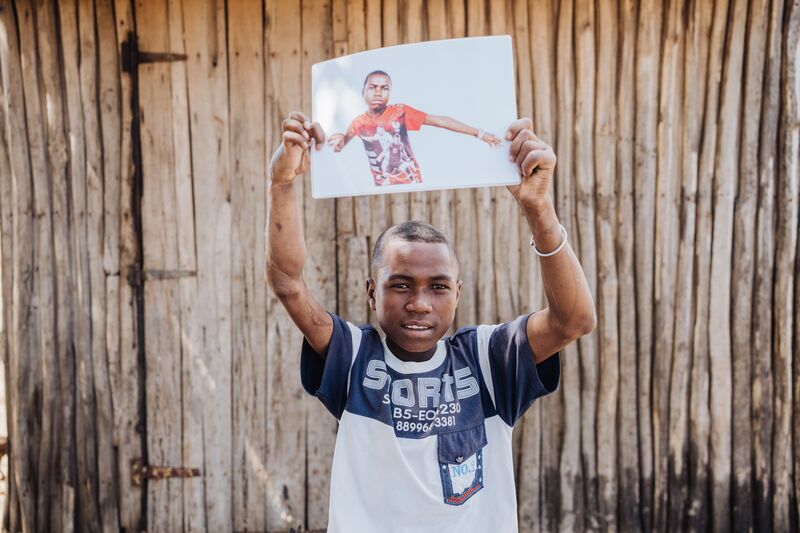
At twelve, Pierre already understood that helping on the farm was a mark of manhood in his community. In his village, where families rely on farming, this is one of the ways boys come of age. Growing up, he had watched his older brothers work alongside their father whenever they were not in school, digging the fields, tending cattle, and carrying their weight within the family. They walked to the fields with farming sticks in hand, tools Pierre longed to carry the same way.
To those who meet him today, Pierre looks like a boy determined to live fully. Yet behind his energy and curiosity was a childhood shaped by pain and perseverance.
When Pierre was six months old, a severe infection appeared on his face and spread to his arms, causing extensive skin damage and leaving large open wounds. For months, the family sought treatment, visiting doctors and spending what little they had. Eventually, the infection healed. But as the wounds closed, his skin tightened, pulling his right arm into a contracture. His elbow, wrist, and fingers locked and immobility set in. Doctors had done all they could; further treatment was out of reach.
Pierre adapted. He worked in the fields and helped his family, holding farming tools differently than the other boys, compensating with his body where his arm could not. He had to push through pain and beyond normal limits. “He can do some tasks on the farm,” Verisoa said, “but he can’t cut wood because of his hand.”
Even then, Pierre’s body often reminded him of its limitations. On his father’s bicycle, one of his favorite activities, he learned to adapt, adjusting his grip and balance so he could ride like other boys his age.
School, too, brought its own challenges. “People make fun of me because of my hand,” Pierre said. When it happened, he refused to fight back. “I didn’t want to argue with them, so I told the teacher what they were doing.” Still, the teasing continued. Yet Pierre never gave up on learning. “I enjoy studying because I want to learn more and become successful,” he said.
Unleashing a Future
Years later, hope arrived through family; Pierre’s uncle, who knew of Mercy Ships, told the family about a possibility they had never imagined: free surgery.
“He told me that there were some foreigners who could help heal me. I believed him, so I went for the screening,” Pierre explained.
When Pierre arrived on the Africa Mercy®, surgeons knew his case would be complex. An infection that could have been treated early had spread, damaging skin, muscle, and blood vessels. Over time, the body healed by pulling the skin together, locking the arm in place with scarring.
Volunteer plastic surgeon Dr. Tertius Venter described the challenge: releasing the contracture would leave a large imperfection. Years of immobility had shortened Pierre’s blood vessels. The team needed to reconstruct his arm using muscle from his abdomen and reconnect blood vessels under a microscope.
The surgery took nearly ten hours. When Pierre woke up, his arm was straight for the first time in his life. For his father, the moment was overwhelming. “I was very satisfied,” Verisoa said. “I saw that it had changed. His hand had become like mine.” Surgery didn’t make Pierre capable; it freed his abilities.
Years of immobility meant Pierre’s muscles had never fully developed. To regain function, he needed intensive rehabilitation, retraining his elbow, wrist, fingers, and hand to move the way they were meant to.
Volunteer hand therapist Kaylee Earll led the work. When Kaylee first met Pierre, he had stayed in the hospital a long time and faced complications. “He was quite frustrated and tired of being there,” Kaylee said. “But he was still trying. He still gave everything.”
Progress came slowly, through repetition, play, and persistence. To motivate him, the team borrowed bicycles from crew members and had Pierre ride along the dock, turning therapy into movement and possibility. “He’s smiling, he’s engaged,” Kaylee said. “He’s requesting that we do things, and he often suggests exercises himself and actually succeeds.”
Before surgery, Pierre’s arm had been functional, but only through constant adaptation. Now, Kaylee explained, he would no longer have to compensate in the same way. He would be able to use both arms properly, easing the strain and pain that would have otherwise followed him into adulthood.
By the time he was discharged, Pierre was ready. “He danced all the way through the hallway to the gangway,” said volunteer nurse Jenna Cooper from the United States, who had cared for him. “He captured our hearts.”
Celebrating Healing
Back in their village, healing is never private. It belongs to the family, the community, and the village itself.
“When I saw his hand, I truly danced for joy,” his mother, Estheline, said. “We celebrated from morning until night.”
For Verisoa, the celebration was thanksgiving. “I sacrificed two goats because my child is alive.” Pierre’s healing didn’t change who he was; it allowed more of him to emerge.
Back in the fields, the difference is clear. Estheline sees it in the way her son now works alongside the family. “The advantage now is that he can use both hands and really work,” she said.
Pierre feels the change in the smallest moments. Riding a bicycle no longer requires careful adjustment, and he has a better grip on farming tools. “Before, I couldn’t use my hand to hold an axe,” he said. “But now, I can.”
His father watched him with quiet pride. “I want him to become a man like others,” Verisoa said. “To be better than me.”
Want to help children like Pierre access life-changing care? Learn more about how you can support this work.
Recent Comments