
Five billion people. That’s how many people currently have no access to safe, timely, or affordable surgery, according to the Lancet Commission on Global Surgery. To put that number in context, it’s nearly two and a half times the population of China. Without access to basic surgical care, preventable conditions kill. Untreated fractures leave people permanently disabled. Mothers die during childbirth from complications that a trained surgeon could resolve in under an hour. The scale of the problem is staggering, and the burden falls almost entirely on low and middle-income countries.
Australia has a growing and meaningful role in closing this surgical gap, through development partnerships, volunteer programmes, and organisations like the Royal Australasian College of Surgeons (RACS) and the Department of Foreign Affairs and Trade (DFAT). Mercy Ships Australia, one of the most established international organisations working in this space, has deployed hospital ships and trained local health workers in sub-Saharan Africa for decades, demonstrating what sustained commitment can achieve.
Understanding the Global Surgery Crisis
The Lancet Commission estimates that 18.6 million people die each year from conditions treatable with surgery. Lack of access to surgical care now accounts for more deaths than HIV/AIDS, malaria, and tuberculosis combined. Most of this burden sits in sub-Saharan Africa and Southeast Asia, where healthcare infrastructure is thin and medical workforces are chronically underfunded.
In sub-Saharan Africa, there are roughly two physicians per 10,000 people. Australia’s ratio sits closer to 40 per 10,000. That gap in the surgical workforce deficit tells you most of what you need to know about why the global surgery crisis is so difficult to close. The burden of surgical disease in these regions grows every year, while the capacity to treat it barely moves.
The Importance of Access to Safe Surgical Care
Surgery is not an optional extra in healthcare. It is essential. Trauma, cancer, maternal health complications, congenital conditions, orthopaedic problems in children, the limb complications of poorly managed non-communicable diseases like diabetes: all of these require safe surgical intervention at some point. Without it, patients face permanent disability or death.
The absence of surgical care also compounds other health challenges. A mother who survives childbirth but develops an obstetric fistula, without surgical repair, may face years of physical suffering and social isolation. A child born with a cleft palate who never receives corrective surgery may struggle to feed, speak, or attend school. These are not abstract statistics. They are the daily reality for millions of families across low-income regions, with consequences that ripple across entire communities.
Access to surgical care is also directly tied to achieving universal health coverage, a commitment embedded in the UN Sustainable Development Goals. Surgery must be treated as a core component of primary healthcare systems, not a luxury reserved for wealthier nations. Healthcare affordability and surgical access are two sides of the same coin: one without the other solves nothing.
Barriers to Surgical Access in Low and Middle-Income Countries
Several interconnected factors block access to essential surgical care in low and middle-income countries. The most immediate is workforce shortage. Many countries simply don’t have enough trained surgeons, anaesthetists, or perioperative nurses to meet demand. In parts of sub-Saharan Africa, there is one surgeon per 100,000 people.
Facilities are another major constraint. Operating theatres require sterile environments, reliable electricity, functioning anaesthesia equipment, and a consistent supply of surgical instruments and medications. In many rural hospitals, even one of these elements is missing, and that’s enough to make surgery impossible or dangerously unsafe. Maintaining sterile environment protocols requires not just equipment but ongoing training, supervision, and a reliable medical supply chain.
Then there’s cost. Even where surgical services exist, out-of-pocket healthcare costs can amount to months of household income for families living below the poverty line. Many people delay treatment until conditions become inoperable, or go without entirely. Morbidity and mortality rates in these settings reflect not just the lack of theatres, but the economic impossibility of accessing the ones that do exist.
The Role of Australia in Global Surgery
Australia’s contribution to addressing the global surgery crisis spans several decades.The Australian Government’s international health programs through DFAT represent some of the most sustained investment in regional health equity from any donor country in the Asia-Pacific.
Surgical System Strengthening in the Indo-Pacific
The Indo-Pacific sits close to home for Australia, and the surgical needs of the region are pressing. Countries like Papua New Guinea, Timor-Leste, and many Pacific Island nations face critical shortages of trained surgical staff, limited operating theatre availability, and health budgets that don’t stretch far enough to meet demand.
Sustainable improvements require more than building hospitals. They require long-term investment in surgical training programmes, clear national surgical plans, functional supply chains for medical equipment, and governance systems capable of managing and growing a surgical workforce over time. These are slow-moving, unglamorous parts of health system development, but they’re the parts that create lasting results.
The Challenges of Short-Term Surgical Missions
Short-term surgical missions have a place, particularly in acute emergencies where local systems have collapsed, but they have well-documented limitations. Without follow-up care, continuity of treatment, or investment in local capacity, the benefits are often short-lived. Surgical mission limitations aren’t a reason to abandon the model entirely, but they are a reason to design missions with long-term system strengthening built in from the start.
There is also a risk that missions inadvertently draw patients and resources away from existing local facilities, or create a dependence that persists after the team leaves. The most effective approach combines immediate relief with a clear plan for sustainable healthcare development that builds lasting local capacity. When mission teams leave behind trained surgeons, improved protocols, and stronger institutions, the impact multiplies long after the ship departs.
National Surgical, Obstetric and Anaesthesia Plans
National Surgical, Obstetric and Anaesthesia Plans (NSOAPs) are among the most practical policy tools available for countries trying to strengthen their surgical systems. Developed with WHO guidance and support from organisations like RACS, these plans map out a country’s current surgical capacity, identify gaps, and set measurable targets for improvement across workforce, infrastructure, and service delivery.
Countries with active NSOAPs tend to attract more consistent international support because they can demonstrate national commitment and a framework for accountability. Ethiopia, Zambia, and Tanzania have all developed plans that channelled resources toward meaningful surgical system reform. The World Health Organisation’s guidance on surgical, obstetric and anaesthesia care provides the international framework that underpins much of this work, and is worth reading for anyone seeking to understand what a functional surgical system actually requires.
Australia actively supports NSOAP development across the Pacific and Southeast Asia through both DFAT funding and RACS expertise, making it one of the stronger donor partners in this space.
Safe Anaesthesia and Sterile Operating Theatres
Two things are non-negotiable in safe surgery: quality anaesthesia and a sterile operative environment. Without safe anaesthesia, even straightforward procedures carry an unacceptable risk of death or serious harm. Without sterile conditions, surgical site infections can turn a successful operation into a fatal outcome. The global anaesthetic crisis receives far less attention than the shortage of surgeons, but it is just as deadly.
In Australia, anaesthetists complete years of specialist training and work within rigorous clinical governance frameworks. In many low-income countries, anaesthesia is administered by nurses or auxiliary staff with minimal training, using equipment that may be outdated or poorly maintained. Dedicated anaesthesia training programs and targeted equipment support are among the highest-return investments in global surgical care.
Mercy Ships runs a Nurse Anaesthesia Diploma Program developed in direct response to requests from host nation health ministries. In Sierra Leone, the program was established specifically to address the shortage of trained anaesthesia providers in government hospitals. In 2024 alone, Mercy Ships provided over 129,000 hours of training to more than 900 healthcare professionals across its programs. Postoperative care standards improved alongside those numbers.
Training the Next Generation of Surgeons
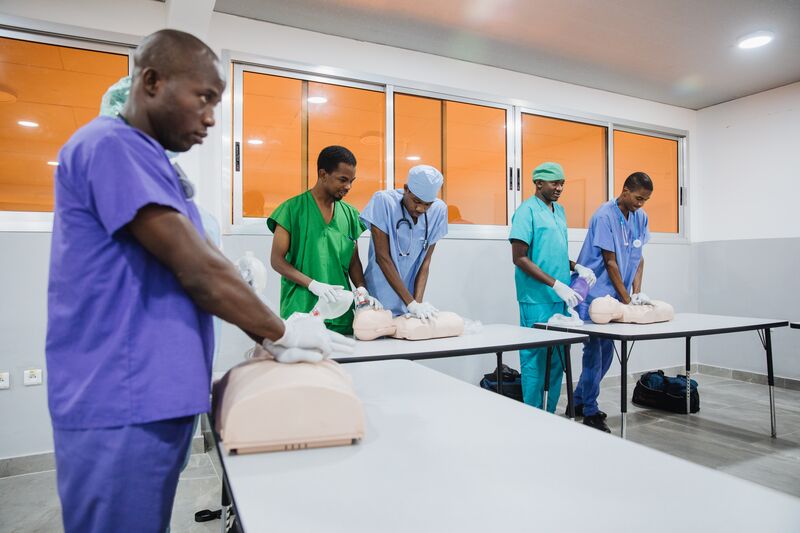
Training is where the long-term solution lies. Building a surgical workforce takes years and requires sustained investment in medical education, postgraduate training, mentorship, and the development of academic surgical departments that can train the next cohort locally. Health workforce migration is one of the biggest threats to low-income health systems: when surgeons emigrate to access better pay and working conditions, the countries that trained them lose the benefit. Investing in in-country training, with in-country career pathways, is the most effective response.
For a concrete example of this work in action, how Mercy Ships engages families and communities in children’s surgical health illustrates what’s possible when direct paediatric surgery is paired with structured education for local health workers. The children who receive surgery are important. The surgeons trained to care for the next generation of children are transformative.
The Role of Medical Equipment and Supply Chains
A trained surgeon in an empty room cannot operate. Equipment matters, and so does the supply chain behind it. Reliable delivery of surgical consumables, functioning anaesthesia machines, sterile processing units, and basic instruments are prerequisites for any surgical programme. Many low-income hospitals have operating theatres that sit unused because a single piece of equipment has broken down and there’s no budget, spare parts, or technical expertise to repair it. Medical supply chain logistics are as much a part of the surgical gap as workforce training.
Biomedical engineering support, whether through training local technicians or providing targeted technical assistance, is a frequently overlooked part of surgical system strengthening. Since 2020, Mercy Ships Australia has supplied AUD $3 million worth of PPE and medical devices to Small Island Developing States across the Pacific, directly improving health resilience in countries with very limited procurement capacity. Surgical equipment maintenance is not glamorous work, but without it, everything else stops.
Overcoming the Surgical Gap in Developing Countries
Closing the surgical gap requires coordinated action across several dimensions at once. Infrastructure development, workforce training, equipment supply, healthcare financing reform, and strong national surgical plans all need to move forward together. Progress on any one element without the others tends to stall. The surgical gap isn’t a single problem with a single fix; it’s a set of interconnected failures that require an integrated response.
The most effective programs work directly with national governments, embed themselves in local systems, and measure their impact honestly. To understand how hospital ships fit into this broader picture and what the evidence says about their effectiveness, this analysis of hospital ships and medical access is worth reading. Short-term thinking, whether from funders or implementing organisations, tends to produce short-term results. The countries making the most progress have government-owned surgical reform agendas backed by sustained international support.
Australia’s Contribution to the Global Health Agenda
Australia’s engagement with global surgery sits within a broader commitment to international health security and regional stability. Healthy populations are more productive, more resilient, and better equipped to manage the kinds of crises, whether from disease outbreaks, natural disasters, or social instability, that require far more expensive interventions if left unaddressed.
DFAT’s Indo-Pacific health programmes represent a serious investment in this logic. What remains is the need to ensure surgical care is firmly embedded within these frameworks, rather than treated as secondary to vaccination programmes, infectious disease control, or maternal and child health. Surgery touches all of those areas. It is not separate from them, and any health system that cannot perform the bellwether procedures, caesarean section, laparotomy, and open fracture treatment, is not a health system capable of meeting its population’s basic needs.
What Needs to Happen Next
The path forward is well mapped. The Lancet Commission, the WHO, RACS, and a growing body of global surgery researchers have outlined what’s needed: sustained political will, adequate funding, long-term system building, and a genuine commitment from donor countries to treat surgical care as the health priority it is.
Australia has the expertise, the regional relationships, and the development infrastructure to lead in this space. The question is whether surgical care gets the sustained attention it deserves within Australia’s development and foreign policy agenda, and whether individuals and organisations that care about global health equity continue to make the case for it.
If you want to contribute directly, options range from donating or volunteering to simply staying informed and advocating for sustained investment in global surgical access. The work of Mercy Ships shows what’s possible when skilled volunteers, long-term partnerships with local governments, and a commitment to health system strengthening come together. Safe surgical care is not a privilege. For five billion people, making it a reality is one of the defining public health challenges of our time.
FAQs
What is the global surgery crisis?
The global surgery crisis refers to the billions of people worldwide who lack access to safe, affordable, and timely surgical and anaesthetic care.
How does the global surgery crisis impact Australia’s neighbours?
Many Indo-Pacific nations face severe shortages of surgeons, anaesthetists, and operating facilities, increasing reliance on regional healthcare partnerships and outreach support.
What is the role of the Royal Australasian College of Surgeons (RACS) in this crisis?
RACS supports surgical education, clinical mentoring, and healthcare development programmes throughout the Asia-Pacific region.
Why is safe anaesthesia considered a pillar of surgical care?
Safe anaesthesia is essential for modern surgery because it reduces surgical mortality and helps protect patients throughout the perioperative process.
How does Australia contribute to surgical training in the Pacific?
Australia supports postgraduate medical training, clinical placements, and specialist mentoring programmes for healthcare professionals across Pacific nations.
What are the “bellwether procedures” in global surgery?
Bellwether procedures include caesarean sections, laparotomies, and open fracture management, which indicate whether a healthcare system can deliver emergency surgical care.
How does lack of surgery affect economic development in the Indo-Pacific?
Untreated surgical conditions can lead to disability, reduced workforce participation, and long-term financial hardship for families and communities.
What is “catastrophic healthcare expenditure” in a surgical context?
This occurs when surgical costs consume such a large proportion of household income that families struggle to meet basic living expenses.
How does the Australian Department of Foreign Affairs and Trade (DFAT) help?
DFAT supports regional health system strengthening through funding, partnerships, and healthcare development initiatives across the Indo-Pacific.
What is the significance of the 2015 Lancet Commission on Global Surgery?
The commission highlighted the global lack of surgical access and established international targets for improving surgical and anaesthesia care worldwide.
Do Australian surgeons volunteer their time overseas?
Yes, many Australian surgeons, nurses, and anaesthetists volunteer through humanitarian organisations and international surgical outreach programmes.
What is the “surgical gap” in maternal health?
The surgical gap includes limited access to emergency obstetric procedures such as caesarean sections, contributing to preventable maternal and newborn deaths.
How do hospital ships assist in the global surgery crisis?
Hospital ships provide specialist surgical services, training programmes, and healthcare infrastructure support in regions with limited medical access.
How does climate change impact surgical access in the Pacific?
Extreme weather events and rising sea levels can damage healthcare facilities and make emergency surgical care harder to access in remote island communities.
Why is “task-sharing” controversial in global surgery?
Task-sharing can increase healthcare access in emergencies, but concerns remain about training quality, safety standards, and long-term sustainability.
What are National Surgical, Obstetric, and Anaesthesia Plans (NSOAPs)?
NSOAPs are national healthcare strategies designed to strengthen surgical systems, workforce planning, and access to safe anaesthesia services.
How can Australian medical students get involved in global surgery?
Students can join university global health groups, participate in awareness campaigns, support fundraising projects, and pursue global health electives.
What is the burden of surgical disease?
The burden of surgical disease refers to deaths and disabilities caused by conditions that could often be treated or prevented through timely surgery.
How does Australia support paediatric surgery globally?
Australian paediatric specialists frequently support international programmes treating congenital abnormalities and childhood surgical conditions.
Is surgery a cost-effective health intervention?
Yes, many essential surgical procedures are considered highly cost-effective and can significantly improve long-term health and economic outcomes.
How can I support Australian efforts to end the surgery crisis?
You can support accredited Australian healthcare charities, advocate for stronger regional health investment, or contribute to surgical training initiatives.
Recent Comments